

The Bible is an amazing book; the most amazing book to have ever been written. We, as believers in Christ Jesus, believe that it is the inspired Word of God. Therefore, from His Word, we received frequent encouragement, correction, and revelation. There are some passages of the Bible, however, that are downright “scary” or concerning. They are passages that make you think deeply, ushering you into a state of introspection, concern, sobriety, and, hopefully, repentance. You may assume that I am referring to the prophetic passages of the books of “Revelation” or “Daniel” with their revelations of “beasts”, “dragons”, “the antichrist”, “the mark of the beast” and “global catastrophes”. But that is not necessarily the case with these passages. In reality, these passages take it a step further. Let’s explore them (and please note these are are not ranked but listed and are deemed “scary” or ” concerning” based on my personal opinion and observation).
Matthew 10:26-28 – “Both Body and Soul”

26 “So have no fear of them, for nothing is covered that will not be revealed, or hidden that will not be known. 27 What I tell you in the dark, say in the light, and what you hear whispered, proclaim on the housetops. 28 And do not fear those who kill the body but cannot kill the soul. Rather fear Him who can destroy both soul and body in hell.
Matthew 10:26-28 (ESV)
We start off our list with Matthew 10:26-28, three verses spoken by Jesus that are meant to give us a proper perspective on fear and reverence. We are encouraged not be fearful towards anyone or anything, especially in light of things that are being covered up. The hidden will be revealed and the things that “you hear whispered” will be “proclaimed on the housetops”. However, the most concerning part of this passage is found in verse 28, where we are encouraged to not be fearful towards persons who would try to counteract our attempts to do what God has called us to do, even to the point where they would try to kill us for such. They can only kill our mortal bodies but not our spirit nature. Instead, we must revere the LORD God who is able to bring complete destruction of body and soul in hell.
This is quite a revealing scripture of the awesome power of God not just to provide, to forgive, or to comfort, but also to proclaim judgment and execute the said judgment in absolute righteousness. The systems and entrapments of this world could give the impression that our lives are in their hands and that they can basically do anything with and to us that they desire. Political and even (at times) Religious leaders would even try to install fear in us, especially if we may express opposing views. Also, with the high rates of crime of violence, we might feel threatened with the advent of partakers in such activities who would make us feel as if our very security is non-existent. Yet, scripture is telling us to be fearless. Do not be afraid of anything or anyone, no matter what! Instead, Jesus calls us to draw our attention to God Almighty, and why we should focus on Him, revere Him, and walk in obedience to Him. It is more of a “proper perspective building” scripture that seeks to warn us about entertaining tainted ideas that would lead to our eyes straying from understanding the majesty and power of the LORD Almighty.
Deuteronomy 28:20-22 – “Curses, Confusion and Frustration”

20 “The Lord will send on you curses, confusion, and frustration in all that you undertake to do, until you are destroyed and perish quickly on account of the evil of your deeds, because you have forsaken me. 21 The Lord will make the pestilence stick to you until he has consumed you off the land that you are entering to take possession of it. 22 The Lord will strike you with wasting disease and with fever, inflammation and fiery heat, and with drought and with blight and with mildew. They shall pursue you until you perish.
Deuteronomy 28:20-22 (ESV)
This passage is a warning issued to the Israelites from God, through Moses, concerning consequences that they could face due to disobedience and idolatry. Sadly, they endured these consequences of several occasions. What makes this passage concerning is the fact that the consequences involved (1) curses, (2) confusion, and (3) frustration. These three factors involve the Israelites enduring physical diseases and distresses, as well as psychological ordeals which they would have brought upon themselves. The end result of it all if a wasting away of their lives through diseases, fevers, heat, drought, blight, and even mildew. It can cause you to think of many of the same things that we allow to plague our own lives, on a regular basis, because of any sin or transgression that we have not repented of.
Revelation 21:8 – “The Second Death”

But as for the cowardly, the faithless, the detestable, as for murderers, the sexually immoral, sorcerers, idolaters, and all liars, their portion will be in the lake that burns with fire and sulfur, which is the second death.”
Revelation 21:8 (ESV)
The real scary part about this scripture is not just what will happen to those who are found guilty of the mentioned offences, with the consequences being burning in the lake of fire and sulphur (known as the second death). The absolute scary part (at least for me) is that the first offender mentioned here is the cowardly or fearful. This scripture caused me to think of all the things that are an offence to God (murder, faithlessness, sexual immorality, etc) and to also come to grips with the reality that being fearful is one such detestable thing. It caused me to realise that living a life of fear can in fact drag one straight to the flames of the lake of fire. That is why the scripture issues quite arguably the most repeated command in the Bible; “Fear not!” Maybe a lot of the things we take for granted are actually sinful in God’s sight and we really should deal with them with utmost urgency and this scripture is a reminder of such as well as being a general call to repentance and warning of judgment to come.
Matthew 7:13-14 – “The Narrow Gate”

13 “Enter by the narrow gate. For the gate is wide and the way is easy that leads to destruction, and those who enter by it are many.14 For the gate is narrow and the way is hard that leads to life, and those who find it are few.
Matthew 7:13-14 (ESV)
When telling others about the Gospel of Jesus Christ, it is your desire, as well as God’s desire, that all really come to repentance. However, the harsh reality is not everyone will accept Christ. Then comes Matthew 7:13-14 which adds more to this reality. The way that leads to life is very narrow and difficult, and only a few are truly going to find it. The way to destruction, on the other hand, is wide and easy, and many are going to walk that path. This is a sad reality to which not remedy is truly given. It is as if Jesus Himself simply chose to give us a glimpse of the future’s reality. All we are called to do is to not harden our hearts if we hear His voice, and to repent. We are also called to still tell as many persons as possible about the Gospel of Jesus Christ. After all, the few that will find the way to life could still be millions or even billions.
Matthew 7:21-23 – “I never knew you”
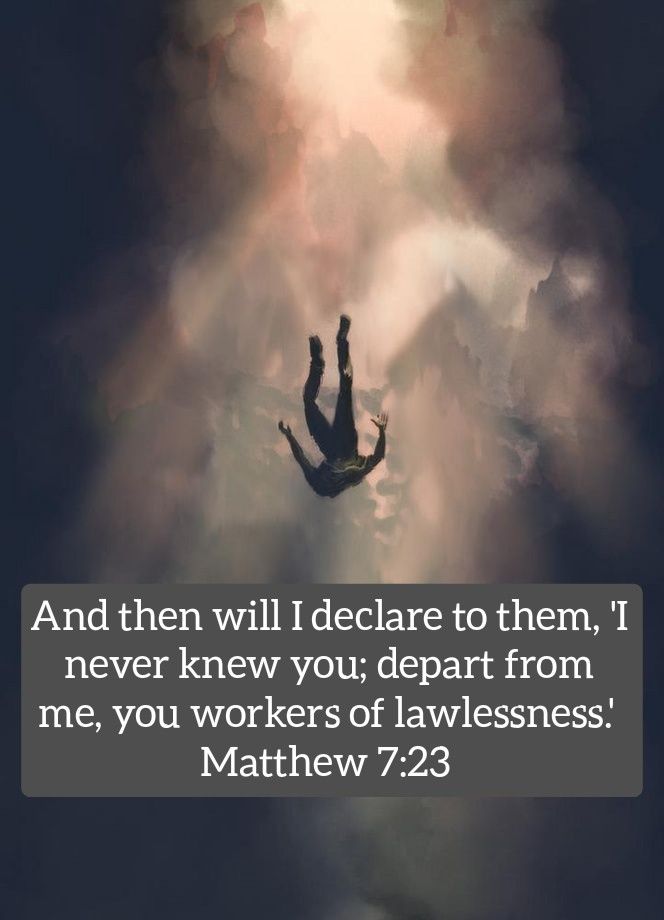
21 “Not everyone who says to me, ‘Lord, Lord,’ will enter the kingdom of heaven, but the one who does the will of my Father who is in heaven. 22 On that day many will say to me, ‘Lord, Lord, did we not prophesy in your name, and cast out demons in your name, and do many mighty works in your name?’ 23 And then will I declare to them, ‘I never knew you; depart from me, you workers of lawlessness.’
Matthew 7:21-23 (ESV)
When I ask persons which scripture passage is the scariest for them, most of them quote for me these two verses. And I can definitely agree with them! Imagine going through life prophesying, doing miracles, winning souls for Christ, assuming church roles, degrees and titles, and then hear at the end of your life, “I never knew you; depart from me“. That has got to be the most tragic of realities. It’s as if you put immense effort into studying for a test, yet you did not consider all that was required for that test, resulting in your eventual failure.
It is clear that God cherishes intimacy and relationship with us above all our comings and goings. If he says to anyone “depart from me” the reason is given; he never “knew” the individual. To know someone is to have a relationship with the person. Therefore, having a relationship and intimacy with God is absolutely key. How then do we achieve intimacy with God? Learn more by checking out the article “5 Keys to Achieving Intimacy with God”:
Revelation 3:14-17 – “Lukewarm Laodiceans”

14 “And to the angel of the church in Laodicea write: ‘The words of the Amen, the faithful and true witness, the beginning of God’s creation. 15 “‘I know your works: you are neither cold nor hot. Would that you were either cold or hot! 16 So, because you are lukewarm, and neither hot nor cold, I will spit you out of my mouth. 17 For you say, I am rich, I have prospered, and I need nothing, not realizing that you are wretched, pitiable, poor, blind, and naked.
Revelation 3:14-17 (ESV)
One of the things the Bible seriously warns against is being “lukewarm”. The imagery of the state of the church of Laodicea is given, where the church is deemed by Jesus as being “neither cold nor hot“. He adds more substance to this statement for us to understand what it means. The Laodecian church, in being “lukewarm”, somehow thought that everything was well with them. They thought that they were “rich”, “prosperous” and needed “nothing”. However, Jesus stated to John on the island of Patmos that they did not realise that they were actually “wretched, pitiable, poor, blind, and naked”.
This then sheds light on what being “lukewarm” means. It is not merely finding yourself somewhere between being “hot” (repentant, passionate, and surrendered) or “cold” (not as passionate, not fully surrendered) for Christ. Now hot is good, and cold is not. However, even a cold individual can still be spoken to and transformation can easily occur in their lives. A cold person also recognises that they are cold and are willing to become hot. On the other hand, a lukewarm person does not recognise their shortcomings. It’s as if in their minds they are absolutely perfect. However, when the Holy Spirit seeks to convict them of something they neglect His call, somewhat like the rebellious Israelites in the wilderness (see Hebrews 3 and 4). Therefore, let the Holy Spirit speak to your heart. And when He reveals areas in your life that need to be worked on, don’t ignore Him and become lukewarm; let Him work.
Matthew 25:24-30 – “Weeping and Gnashing”
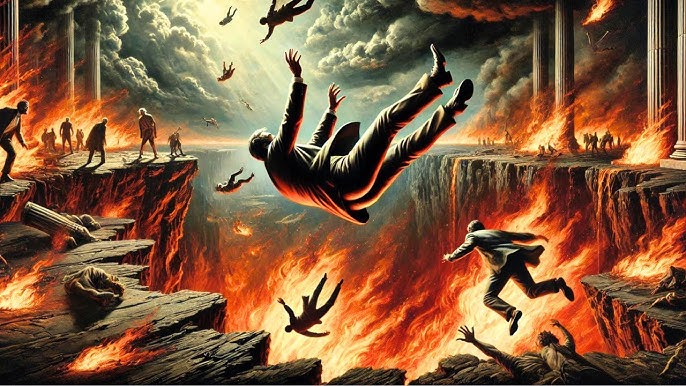
24 He also who had received the one talent came forward, saying, ‘Master, I knew you to be a hard man, reaping where you did not sow, and gathering where you scattered no seed, 25 so I was afraid, and I went and hid your talent in the ground. Here, you have what is yours.’ 26 But his master answered him, ‘You wicked and slothful servant! You knew that I reap where I have not sown and gather where I scattered no seed? 27 Then you ought to have invested my money with the bankers, and at my coming I should have received what was my own with interest. 28 So take the talent from him and give it to him who has the ten talents. 29 For to everyone who has will more be given, and he will have an abundance. But from the one who has not, even what he has will be taken away. 30 And cast the worthless servant into the outer darkness. In that place there will be weeping and gnashing of teeth.’
Matthew 25:24-30 (ESV)
This is an interesting parable of stewardship that Jesus gives, with three men who were given talents of varying amounts. The one who received the least buried his talent and was seriously chastised by his master. Not only was his talent taken and given to another, but he was labelled as “the worthless servant” and cast into “outer darkness“, a place where “there will be weeping and gnashing of teeth.” This scripture is a good reminder of the importance of stewardship, not just of our tangible resources but also of spiritual gifts and offices. We take for granted the gifts, resources, time and opportunities that we are given and waste them, not realising that (1) these things were given to us from God, and (2) redeeming lost and wasted things can be hard, even in some cases impossible. Wasting such resources is wasting God’s resources, as we are only stewards not owners; something to truly think about.
If you want to know more about “Understanding Biblical Stewardship”, check out my article and video series via the link below:
2 Peter 2:1-9 – “Destructive Heresies”

But false prophets also arose among the people, just as there will be false teachers among you, who will secretly bring in destructive heresies, even denying the Master who bought them, bringing upon themselves swift destruction. 2 And many will follow their sensuality, and because of them the way of truth will be blasphemed. 3 And in their greed they will exploit you with false words. Their condemnation from long ago is not idle, and their destruction is not asleep.
4 For if God did not spare angels when they sinned, but cast them into hell and committed them to chains of gloomy darkness to be kept until the judgment; 5 if he did not spare the ancient world, but preserved Noah, a herald of righteousness, with seven others, when he brought a flood upon the world of the ungodly; 6 if by turning the cities of Sodom and Gomorrah to ashes he condemned them to extinction, making them an example of what is going to happen to the ungodly; 7 and if he rescued righteous Lot, greatly distressed by the sensual conduct of the wicked 8 (for as that righteous man lived among them day after day, he was tormenting his righteous soul over their lawless deeds that he saw and heard);9 then the Lord knows how to rescue the godly from trials, and to keep the unrighteous under punishment until the day of judgment,
2 Peter 2:1-9 (ESV)
1 and 2 Peter are pretty deep theological pieces, and this passage in 2 Peter is no exception. The Apostle Peter addresses here the issue of false prophets and teachers and their “destructive heresies”. These heresies are described as “blaspheming the truth” and will be met with certain judgment and wrath from God. As a matter of fact, Peter states that if God brought judgment on (1) the angels that sinned and fell with Lucifer, (2) the world that was flooded in the days of Noah, and (3) the cities of Sodom and Gomorrah, then He was absolutely going to bring judgement on false prophets and teachers.
As a Pastor, I am humbled and admonished by this, to always ensure that I am circumspect in my life and also in what I teach and preach. The Bible has to be the very authority for it is the Word of God. We cannot divert to “doctrines of demons” that seek to deny the divinity of Christ and His ability to save, keep and satisfy. We cannot deny that He is the only source of eternal life and therefore the only way to the Father. As believers and especially as Pastors and Teachers, we must ensure that the truth of the Gospel of Jesus Christ comes from our lives as well as our lips. If not, our portion of judgment will be no less than that allocated for satan, the fallen angels, and even Sodom and Gomorrah.
Luke 17:32-33 – “Remember Lot’s Wife”
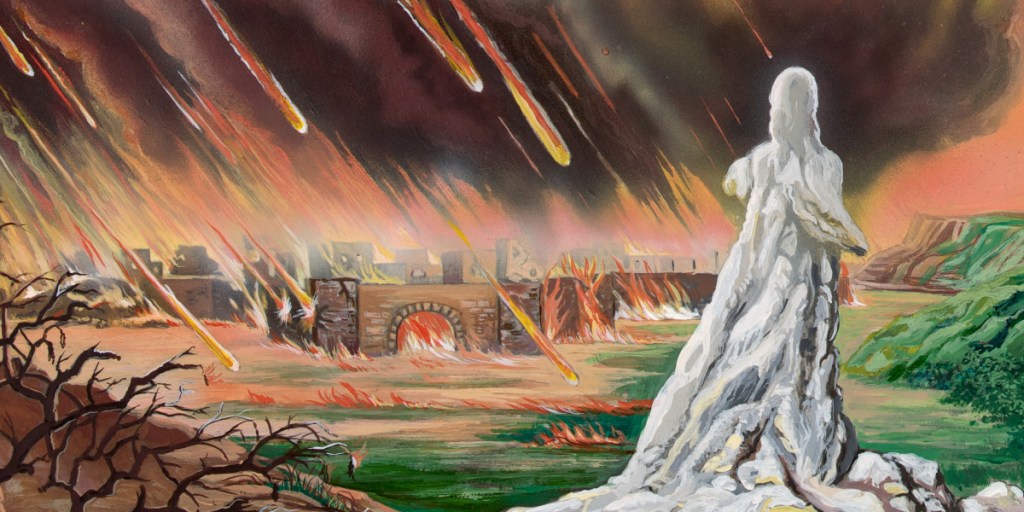
32 Remember Lot’s wife. 33 Whoever seeks to preserve his life will lose it, but whoever loses his life will keep it.
Luke 17:32-33 (ESV)
“Remember Lot’s wife” is one of the most chilling warnings in scripture. Jesus says it in reference to the events of Genesis 19:24-26. Lot, his wife and his two daughters are beckoned by the angels, sent from God, to leave Sodom. They were specifically told to run and to not look back. Lot’s wife did not heed to the warning and, as she looked back at the city being destroyed, she became a “pillar of salt”. Jesus then strengthens this statement by giving a warning; if you love your life, or this life, too much, you will lose it.
Now this is not a message to abhor living. On the contrary it is a message to encourage living but to do so for the glory of God. This means that even when living our minds should be set on Christ and on doing the complete will of God. Galatians 2:20 tells us that we are crucified with Christ but it is now Christ who is living in and through us, not ourselves. 2 Corinthians 5:17 also tells us that if we are in Christ we are “new creatures”. Therefore, when our hearts are surrendered to Christ, He works in us to help alleviate a desire for the things of this world. 1 Peter 2:7-8 tells us that Lot was a “righteous man” whose soul was being “tormented” by the deeds to the residents of Sodom and Gomorrah. So even when he was living among them he did not desire them and their ways. However, his wife was different. She desired Sodom and Gomorrah, and all that they had to offer. Therefore, even in the face of judgment, her desire for such things couldn’t go and she ended up perishing with the very cities that were doomed. In trying to save her life and in refusing to release her desires for the things of this world, she ended up perishing. Yet, Lot and his daughters fled and were saved. Believers, remember Lot’s wife!
1 John 4:7-8 – “God is Love”

7 Beloved, let us love one another, for love is from God, and whoever loves has been born of God and knows God. 8 Anyone who does not love does not know God, because God is love.
1 John 4:7-8 (ESV)
Now this list isn’t ranked. However, if I were to have ranked it, based on my opinion, this scripture would be number one. Many may laugh when I say this and even find it weird to consider this “scary” or “concerning” in any way, but in fact it is. There is a famous song that I learned growing up that helped me to memorise this passage, with the song even quoting the reference at the end. Seeing that it is remembered because of this children’s song, you would see it as a cute message. But it is not that “cute” of a message.
One of the most critical things that we must understand is the concept of “Love”. The first thing we must understand about it is in fact one of the deepest of spiritual truths and revelations; God is Love! Therefore, love is of God and we must show love to show we are children of God. This, of course, involves loving one another. However, a warning is given; the person that does not love does not know God. If you ask many persons, whether they are believers or not, “what is Love”, chances are they will struggle to answer. If we then clearly struggle to even know what Love is, how can we easily claim to be God’s children? To not love or to not know love is to not know God, and to not know God is to be far from Him. There will therefore be no intimacy with Him. It also means that the dreaded message of Matthew 7 could become reality, with Him “not knowing us”. How can all of this be curbed? Know God today. Understand what “God is Love” really means, how He commended His love to us by dying for us even when we were in our sin, and that He loves us unconditionally (see Romans 8:37-39). And in case you are struggling with understanding what love truly is, think about what the Apostle Paul said in Romans 13:8-10 (we will touch on this in a subsequent article so stay tuned).
Conclusion
These scriptural passages shouldn’t be seen as merely “scary”. After all, God has not given us the spirit of fear. Instead we should see them as warnings sent to us directly from the throne of God. We should heed to these warnings and escape every bit of wrath and judgment that is to come. It is also evidence that the primary remedy to all of this is to know God. Many of our problems start when we don’t get to truly know Him and have intimacy with Him. To understand more about achieving Intimacy with God, see the article “5 Keys to Achieving Intimacy with God” below.
 Beacon Of Flavor