
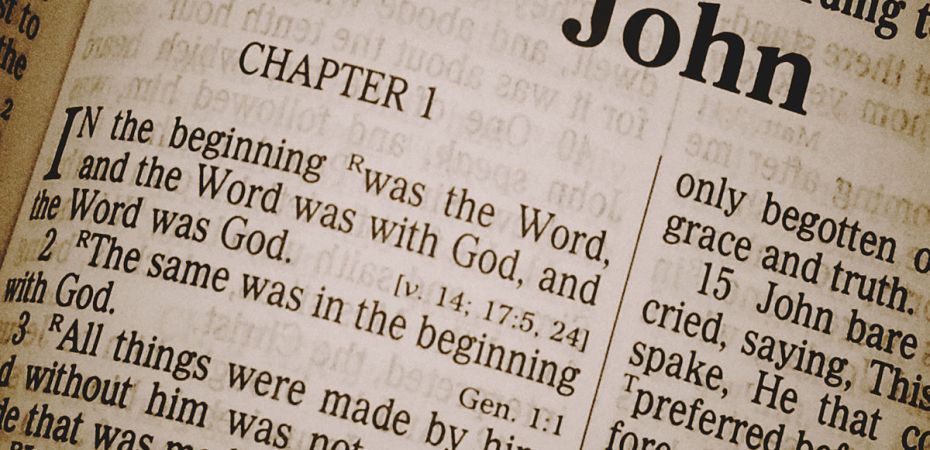
In Part 2 we looked at verses 9 to 18 in the Gospel of John, which revealed more about the nature of Christ and the miracle of Him coming in human form and living among men. You can read Part 2 via the following link:
In this 3rd part, we will be looking at verses 19 to 39. Within these verses, we see a shift in focus to the narrative, the defense, and the expression, not of the Apostle John, but of John the Baptist.
Verses 19-23
19 And this is the record of John, when the Jews sent priests and Levites from Jerusalem to ask him, Who art thou? 20 And he confessed, and denied not; but confessed, I am not the Christ. 21 And they asked him, What then? Art thou Elias? And he saith, I am not. Art thou that prophet? And he answered, No. 22 Then said they unto him, Who art thou? that we may give an answer to them that sent us. What sayest thou of thyself? 23 He said, I am the voice of one crying in the wilderness, Make straight the way of the Lord, as said the prophet Esaias.
St. John 1:19-23 (KJV)
The author of this Gospel account, the Apostle John, is introducing us to someone of his name’s sake; John the Baptist. The Apostle is telling us, in verse 19, that he is now going to present the record of this other John. Now if you’re reading this scripture for the first time you might be wondering “if the Gospel is really about Christ, why is this guy mentioned first?” You might even wonder why the Apostle diverts so sharply to mentioning John the Baptist and this account that he is giving.
John the Baptist’s arrival, as simple as it seemed, was actually prophecy fulfilled. There are two passages of scripture in the Old Testament that are known as the two primary prophecies about the coming of this man:
The voice of him that cries in the wilderness, Prepare you the way of the LORD, make straight in the desert a highway for our God. – Isaiah 40:3
Behold, I am going to send you Elijah the prophet before the coming of the great and terrible day of the LORD. – Malachi 4:5
The prophet Malachi states that, before the coming of the day of the LORD (before the arrival of the LORD Jesus Christ), there was coming one who will act as the precursor to the LORD’s arrival. Such a prophecy would not have been a private message but one that would have been known by most or even all religious leaders and scholars. Malachi even referred to the prophet who was to come as “Elijah”. This did not mean that Elijah was to rise again from the dead to herald in the LORD’s arrival. Instead it meant that there was one who would come in the spirit of Elijah, or rather, with the same ministration as Elijah who would herald the LORD’s arrival. This is first confirmed in verse 21 when the Pharisees asked him if he was Elias (the Greek word for Elijah), to which he answered “no”. Jesus Christ also confirms that John the Baptist was the promised “Elijah” (or promised precursor minister in the spirit of Elijah) in Matthew 11:12-14:
12 From the days of John the Baptist until now the kingdom of heaven suffers violent assault, and violent men seize it by force [as a precious prize]. 13 For all the prophets and the Law prophesied up until John. 14 And if you are willing to accept it, John himself is [the fulfillment of] Elijah [as the messenger] who was to come [before the kingdom].
St. Matthew 11:12-14 (AMP)
Jesus confirms that John the Baptist is this recognized “Elijah” who will operate as a prophetic messenger, in a similar yet greater role than Elijah, introducing the LORD and the Kingdom that is to come.
John is found preaching in the desert a message of repentance and the coming of the Kingdom of God and he is also found baptizing people in the Jordan river (read St. Matthew 3:1-12). Such roles were expected to be performed by the coming Elijah. Therefore, in John 1:19, it was no surprise that the Jews “sent Priests and Levites” to meet with John the Baptist and to question him. Both parties represented the priestly and legal offices within Jewish society. As a result, there had to be persons who could confirm John’s authority from both a spiritual and a legal standpoint. Of course, as we read the Gospel accounts, we would see that the Pharisees and religious rulers were actually more corrupt than righteous.
The Priests and Levites questioned John, asking him who he was. John recognized that their first assumption was probably that he could possibly be the Messiah. So in his first response he made it clear that he was not the promised Messiah. After this they questioned whether he was Elijah or if he was “that prophet” (there is much debate as to who this other prophet is who they were referring to here). It was important for them to recognize the Messiah and his precursor. However, John answered all in the negative. He simply stated the famous words originally penned by the prophet Isaiah; “I am the voice of one crying in the wilderness, Make straight the way of the Lord“.
In truth, John was the promised Elijah. He was also a prophet. As a matter of fact, John the Baptist was seen as greater than all who were born of a woman (read Luke 7:28). Yet, John was a humble man. His focus was not on his title but on his task. He knew he had to be, not just “a voice” or “another voice”, but he had to be THE VOICE crying in the wilderness. There is so much significance to the imagery used here, where John has to minister in a desert; a dry area in need of life-giving water. John’s ministry marked the end of a 400 year-period of silence where there was no true prophetic voice or utterance. This was a period of dryness for Israel who needed a voice to cry out in their wilderness situation.
Verses 24-28
24 And they which were sent were of the Pharisees. 25 And they asked him, and said unto him, Why baptizest thou then, if thou be not that Christ, nor Elias, neither that prophet? 26 John answered them, saying, I baptize with water: but there standeth one among you, whom ye know not; 27 He it is, who coming after me is preferred before me, whose shoe’s latchet I am not worthy to unloose.28 These things were done in Bethabara beyond Jordan, where John was baptizing.
St. John 1:24-28 (KJV)
The Priests and Levites who questioned John were members of the religious sect called “The Pharisees”. They were members of one of the two large sections of the Jewish Sanhedrin. In the previous verses, they questioned John’s identity. After seeing that he was neither the Messiah (the Christ) nor Elijah, they began questioning him about his actions.
In our modern Church context, baptism is a normal sacrament carried out by Ministers of the Gospel. However, in those days, it was seen as a purification act that could have only been conducted by the Messiah Himself, a great prophet, or even possibly a priest. John responds to them by stating that he was only “baptizing with water”. For the Jews baptism was a deeply spiritual act, with the use of water even seen as an actual act of cleansing. However, for John, it was purely symbolic. The true act of baptism would come, according to John, when the promised Christ (the anointed one) arrives. Matthew 3:11 gives more context to this specific response, where John the Baptist says:
I indeed baptize you with water unto repentance: but he that cometh after me is mightier than I, whose shoes I am not worthy to bear: he shall baptize you with the Holy Ghost, and with fire
St. Matthew 3:11 (KJV)
John was not issuing this baptism but was helping to pave the way for the one who will come to give such a baptism; one that would involve being filled and submerged in the Holy Spirit and His refining fire. It would be a baptism that would be both purging and power-enduing. John is so focused on this coming Messiah that he highlights two important things to the Pharisses:
- The Messiah was actually standing among them yet the religious leaders did not recognize Him.
- The Messiah’s holiness to the point where John (though being the promised Elijah) does not see himself as even being worthy to loose the latchet of His shoes.
John’s expression here is to further intensify the importance of the times that they were living in and the importance of the promised one, who was already present among them.
Verses 29-39
29 The next day John seeth Jesus coming unto him, and saith, Behold the Lamb of God, which taketh away the sin of the world. 30 This is he of whom I said, After me cometh a man which is preferred before me: for he was before me. 31 And I knew him not: but that he should be made manifest to Israel, therefore am I come baptizing with water. 32 And John bare record, saying, I saw the Spirit descending from heaven like a dove, and it abode upon him. 33 And I knew him not: but he that sent me to baptize with water, the same said unto me, Upon whom thou shalt see the Spirit descending, and remaining on him, the same is he which baptizeth with the Holy Ghost. 34 And I saw, and bare record that this is the Son of God. 35 Again the next day after John stood, and two of his disciples; 36 And looking upon Jesus as he walked, he saith, Behold the Lamb of God! 37 And the two disciples heard him speak, and they followed Jesus. 38 Then Jesus turned, and saw them following, and saith unto them, What seek ye? They said unto him, Rabbi, (which is to say, being interpreted, Master,) where dwellest thou? 39 He saith unto them, Come and see. They came and saw where he dwelt, and abode with him that day: for it was about the tenth hour.
St. John 1:29-39 (KJV)
One day after speaking with the Pharisees, John the Baptist sees Jesus coming towards him. John then gives a brief narrative of Jesus’s identity as the promised Christ, of his inferiority to Jesus, and the confirming factor that allowed him to know for sure that Jesus was indeed the Christ.
John mentions that Jesus is “the Lamb of God who takes away the sings of the world”. This is a deeper revelation than anyone had about Jesus at the time. As a matter of fact, many of Jesus’ own disciples did not realize this until after His death, burial and resurrection. John, however, recognized this. Such a confirmation came to him when He was first told by a voice to go and baptize in the wilderness. John, of course, recognized this voice as the voice of God.
Now, as we saw earlier, act of baptizing in those days would have captured people’s attention. By capturing their attention, he would then proclaim the message of preparation for the coming of Christ to them. John then confirms that the same voice that told him to baptize is the same voice who then told him to look for the one “on whom the Spirit will descend”; that person is the Christ. We see in St. Luke 3:22 that the Holy Spirit descended on Christ in the form of a dove. This signified Him being the Christ, the anointed one, the true Son of David, Son of Man, and Son of God. John even mentions that Christ is “preferred above him (John)” and that he (John) “did not know Him, but that He should be made manifest (known) to Israel“, which is why John had to commence the baptism act.
Here, John actually (though indirectly) confirms that he is the promised Elijah. He knew that Christ was the Lamb of God (verse 29) and he bore record that Jesus was indeed the very Son of God (verse 35). He would have also known about the prophecy of Isaiah 40:3 (a voice crying in the wilderness), since he quoted it to the Pharisees. We can therefore see here that John was simply exercising humility and, as said before, focusing on his task and not on his title. John the Baptist also does what John the Apostle sought to do in his Gospel account; confirm and prove Jesus’ divine nature. John the Baptist states that Christ “is preferred over him” because He (Christ) existed “before him“.
The following day something significant happens. John declares Jesus to be the Son of God in the presence of two of his disciples. These two disciples did not receive a revelation as one that John received. However, they knew that their mentor was a true prophet and a man of God. Therefore, upon John making such a statement, a transition moment occurred. John realized that his major task was being fulfilled and that it was now time for even his disciples to follow Jesus Christ, who’s ministry was about to commence. This is an important lesson, even for us in this modern Church era, to understand the overall Kingdom cause which is much larger than any of us. John was willing to give up the attention that he was receiving and even to give up his very followers so that the Kingdom’s cause can be achieved.
The disciples who then left John and followed Jesus approached Jesus. He inquires from them as to what they were seeking, to which they replied, “Rabbi, where do you live” (“Rabbi” means “Master”, which signified that the two disciples were transitioning in their ministry from John to Jesus. These two disciples probably had many questions, they probably were uncertain about a lot of things. However, they knew that there was something special about this Man. Therefore, a good starting point would be to go with Jesus and get to know Him more. In answering their request, Jesus invites them to “come and see” where he lives which, as was explained, occurred at the 10th hour (in Hebrew culture this was about 4pm). It would have had to have been a late hour where they needed a place to stay, as scripture stated that “they abode with him that day”.
Additional Note: John and Jesus’ relationship
It is intriguing that John states, in verse 31, that he did not know Jesus. It may then present a point of confusion, as we know that both Jesus and John would have been related (read St. Luke 1:36). This, however, can be explained in two points:
Point #1: John’s narrative here is in reference strictly to Jesus’ identity as the Messiah. His perception of Jesus is not contorted by family relations or any familiarity. This shows that John is absolutely consumed with his calling as “the voice crying in the wilderness” that he is seeing Jesus now as being the promised Messiah. It could have possibly meant that such a revelation never came to him before in knowing Jesus growing up.
Point #2: John the Baptist grew up with his parents, Zechariah and Elizabeth, in the hill country of Judea. Jesus grew up with Joseph and Mary in Galilee. Both settlements were about 100 miles apart. It is estimated that a journey between both settlements could have taken 10 to 12 hours to complete; something that most likely would not have been done every day! This shows that, even though they may have known each other growing up, their interactions most likely would have been heavily limited due to geographic restrictions.
To Be Continued…
(Part 4 will be the final part of this article series on the Gospel of John Chapter One)
 Beacon Of Flavor
[…] Word Study: Exploring the Gospel of John Chapter 1 (Part 3) […]