
The Gospel of John chapter one is made up of 51 verses and, not surprisingly, there is a lot going on. Tradition holds firm (as well as historical and literary evidence) to the fact that the Gospel of John was written by the Apostle John, “the disciple whom Jesus loved”, between the years AD 90 and AD 100 in Ephesus of Asia Minor (modern-day Turkey). This would make the Gospel of John the last of the four Gospels (the others being Matthew, Mark and Luke) to be written.
Let’s now take a step-by-step look at this beautiful chapter of the Gospel of John. In this article we will focus on verses 1 to 8.
Verses 1-3
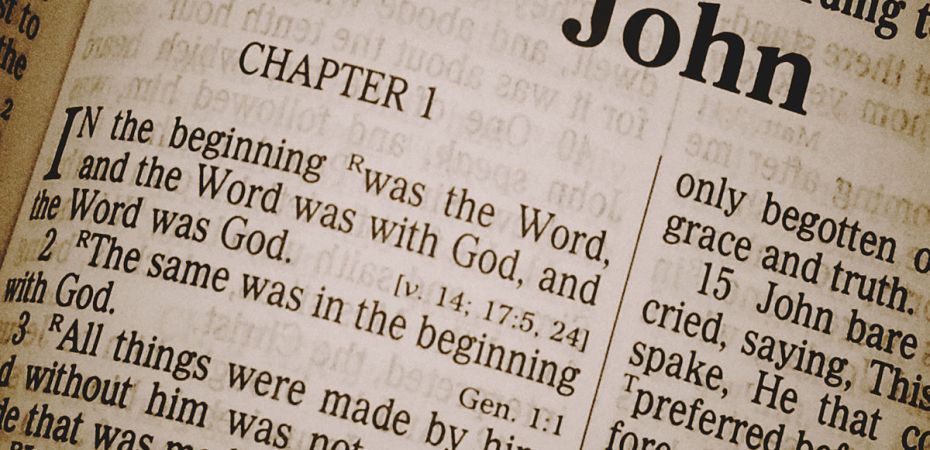
(1) In the beginning was the Word, and the Word was with God, and the Word was God. (2) The same was in the beginning with God. (3) All things were made by Him; and without Him was not anything made that was made
St. John 1: 1-3 (KJV)
Chapter one of the Gospel of Matthew starts by giving a genealogy of Jesus Christ, chapter one of the Gospel of Mark starts by mentioning John the Baptist with immediate action, and chapter one of the Gospel of Luke starts by Luke giving his greetings to Theophilus before mentioning Zacharias and the birth of John the Baptist. However, as we see here, the Gospel of John chapter one focuses on giving an extensive introduction of Jesus Christ. It does not focus on His birth or any aspects of His early life. Instead it focuses on introducing something that the entire Gospel of John sets its sight on; the divine and eternal nature of Jesus Christ.
The first three verses focus on introducing Jesus in terms of (1) His nature, (2) His relationship with God, and (3) His relationship with creation. John is phenomenal an attributing to Jesus the title of being “the Word“. The term “the Word” comes from the Greek word “logos” which means “thought”, “speech”, “account”, “reason”, “standard”, or “logic”. Therefore, when John refers to Jesus as “the Word” he is actually showing Jesus in a light that is quite phenomenal. He showed Jesus as the physically manifested divine thought, reason, will, standard and logic of God. God’s will, of course, cannot be separated from Him, hence why Jesus Christ was not just the manifested Word of God; He was and is God. However, despite God and the Word being one, God also consulted and worked along with the Word. That’s why He said:
“And God said, Let us make man in our image, after our likeness…”
Genesis 1:26 (KJV)
John therefore presents, in true confession, the complex nature of God’s trinity. His statement in verse one can be seen not just as a statement of a divine fact but as a humble reminder that knowing the nature of God is no simple task. Knowing and understanding God’s nature goes beyond what the human mind, our present reality, and the laws of physics, space, time and relativity can fathom. That is why John presents verse one as a triad of three seemingly confusing but phenomenal facts;
- in the beginning was the Word
- the Word was with God
- the Word was God.
John 1:1 also adds substance to Genesis 1:1 in two main ways. Firstly, while Genesis 1:1 gives the statement of God, in the beginning, making the heavens and the earth, John 1:1 makes the statement of God’s existence before the beginning. Genesis 1:1 therefore highlights God’s power and creativity and John 1:1 highlights God’s eternal nature. It shows not just that He created all things but that He Himself was not created. Secondly John 1:1 adds substance to Genesis 1:1 by highlighting the revelation of who was among the “us” mentioned in scripture. God the Father was, of course, revealed since the beginning of Genesis as well as the Holy Spirit (Genesis 1:2). However, God the Word was not revealed but only prophesied about in the Old Testament. The revelation of the very Word of God, the very nature of God’s logic, thought, and, overall, the essence of who He is (which is He Himself) came in the person of Jesus Christ. Please note that I am not saying that Christ is merely “God’s thoughts”. God Himself would have thoughts, logic and reasoning (His thoughts are peaceful towards us and not evil [Jeremiah 29:11] and He says that we can come and reason together [Isaiah 1:18]). However, Christ, the Word of God, is the essence and source of all of those attributes of God, which makes Him completely one with God and makes Him God at the same time.
Verses 2 and 3 then support verse 1 by showing that Christ was indeed in the beginning with God (verse 2) and He made all things (verse 3). Verse 2 was John basically reiterating what was mentioned in verse one; this Word of God was with God in the beginning when all things were created. Then verse 3 adds more light to verse 2 by showing that the Word who was with God and is God is the creator of all things. This highlights, even further, the triune nature of God, taking into account Genesis 1:2 which mentions “God’s Spirit moving on the face of the waters”. John 1:1-3 therefore work together in supporting and giving light to other scripture passages in showing the truth of God’s triune nature, while focusing on properly introducing God the Son, or God the Word; Jesus Christ.
Verses 4-5
“(4) In Him was life; and the life was the light of men. (5) And the light shineth in darkness; and the darkness comprehended it not.”
St. John 1:4-5 (KJV)
Verses 4 and 5 then show an additional dynamic of Jesus Christ; Him being life. This life, in return, did three main things:
- It became light to all men
- It confronted darkness
- It confused and overcame darkness
When Christ was revealed to men He revealed the source of life; Himself. The Greek word that is used for life in this context is “Zoe” which refers to uncreated, eternal life. Two other Greek words are used in scripture to depict life; “Bios” which refers to life of the human body (Luke 8:14) and “Psuche” which refers to the psychological life of the human soul (mind, emotion and will – Matthew 16:25). As a matter of fact the words “Biology” and “Psychology” were derived from “Bios” and “Psuche” respectively. “Zoe“, on the other hand, refers only to divine life that is found in God. Therefore, verse 4 is showing us that Christ contained life that was eternal and Godly. Then, since He created all things, such life would bring about both biological and psychological life. This further shows that all life comes from Him.
Although life is sustaining, John wanted to focus on the life bringing light. He wanted to focus on the dichotomy of light and darkness, there being only two sides in which we can take. The eternal life in Christ brought light to men. It brought revelation, clarity and hope, as light is intended to bring. You would, after all, feel much better an safer in a well-lit room than in a pitch-dark room. The life of Christ Jesus became light for men and confusion for darkness.
This world system is being orchestrated by the prince, or ruler, of the this world; the devil (John 14:30). Therefore, naturally, there would be darkness abounding within the world systems. It would be an audacious thing for light, therefore, to enter and to shine into the darkness. The word “comprehend” comes from the Greek word “katelaben” which means “to lay hold of” or “to seize”. The darkness was not able to comprehend, lay hold of, seize, or overcome or understand the light. It relates to the question that was asked in Romans 11:34 where Paul asked “who can know the mind of God, and who can understand His ways?”. Darkness and the ruler of this world have no part in Jesus Christ (John 14:30) so therefore darkness could not comprehend Him. Furthermore, darkness could not overcome Him as (1) comprehension could not be established, and (2) the light came from the very eternal, Godly life of Christ. It is therefore evident that Christ Jesus does have authority over ever form of darkness in existence. That is why He, being light, had the audacity to confront darkness in its own home turf. Darkness, on the other hand, was unable to lay hold of, or seize, the light, which allowed Jesus Christ free entrance.
Verses 6-8
“(6) There was a man sent from God, whose name was John. (7) The same came for a witness, to bear witness of the Light, that all men through him might believe. (8) He was not that Light, but was sent to bear witness of that Light.”
St. John 1:6-8 (KJV)
In the midst of introducing Jesus Christ and explaining His nature, the Apostle John takes a brief moment to introduce another John into the narrative; John the Baptist. John the Baptist is critical to the coming of Jesus as he fulfilled an important prophecy; he was the herald announcing Jesus’ arrival.
There are two main Old Testament scriptures which prophesy the arrival of John the Baptist and his purpose. They are:
“The voice of him that cries in the wilderness, Prepare you the way of the LORD, make straight in the desert a highway for our God.”
Isaiah 40:3 (KJV)
and
“Behold, I will send you Elijah the prophet before the coming of the great and dreadful day of the LORD:”
Malachi 4:5-6 (KJV)
In this same chapter, John 1:22-23, John the Baptist was asked of people to identify himself. They desired to know who this mysterious preacher was. Honestly, you could not blame them for being inquisitive. John the Baptist was the first active preacher and prophet from God that Israel had since Malachi, which was 400 years before John’s day. John replied to the people with the words of Isaiah, saying that he was “the voice of him that cries in the wilderness”, with his person being to encourage preparation for the coming of the LORD. This way that was to be made straight is even described by both Isaiah and John as “the way of the LORD”. This is ownership, sovereignty and dominion, and all kingdoms of the earth must make way for Him. The way is His. That is why He encourages us to walk in His way.
We also see that Malachi prophecies about the coming of Elijah who would be sent before the coming of the LORD. John the Baptist is the fulfilment of this prophecy, which was confirmed by Jesus Christ Himself, in Matthew 11:13-14, where He said:
(13) For all the Prophets and the Law prophesied until John, (14) and if you are willing to accept it, he is Elijah who is to come.
Matthew 11:13-14 (ESV)
John is then described as a witness of the Light to tell others about the Light. He is identified as being “sent by God” which must be understood before all other things. This proved the authenticity and dependability of his testimony, message and ministry. Others, in return, would believe. This shows us that in order for us to declare Jesus Christ to others we must have an encounter with Him for ourselves. John was seen as a “witness” of the Light; He encountered and knew Jesus Christ. It was also important to note that John was not the Light. This might not seem like something of confusion to us now, but to the Jews back then it had to be mentioned. Remember, they would have not known of a prophet as the last one existed 400 years before John’s coming. Also, John was just the messenger to announce the arrival of the King, as the coming of all Kings is always announced.
TO BE CONTINUED
You can read “Word Study: The Gospel of John Chapter 1 (Part 2)” here.
Sources of Assistance
 Beacon Of Flavor
[…] https://thegospelsteward.com/2020/04/08/word-study-exploring-the-gospel-of-john-chapter-1-part-1/ […]
[…] Word Study: Exploring the Gospel of John Chapter 1 (Part 1) […]